A gentle Diwali reflection and new beginnings guide: clear inner clutter, forgive, practise gratitude and set one kind intention for the year ahead.
In the weeks before Diwali, homes across India go through a familiar ritual. Cupboards are emptied, old newspapers are sold, curtains are washed and the forgotten corner behind the fridge finally sees daylight. There is something deeply satisfying about it: clearing space so that light can come in.
This year, as Diwali arrives on Sunday 8 November 2026, we would like to invite a quieter version of that same work. A Diwali reflection and new beginnings practice is simply this: an inner cleaning to match the outer one. Before the diyas are lit, what could you set down? What chapter of the past year is ready to close?
This is not religious instruction. Diwali is celebrated in many ways by many families, and its themes of light, renewal and togetherness are widely shared. Here we treat it as a natural pause in the calendar, a moment to look back with honesty and forward with gentleness.
Diwali reflection and new beginnings: why now
Most of us move through the year at speed. Work targets, school schedules, family responsibilities and the daily stream of messages leave little time to ask how we are actually doing. Festivals interrupt that rhythm.
For many Gujarati families, the new year itself begins in the days right after Diwali, which makes the season an especially fitting threshold. Whatever calendar you follow, the symbolism is easy to feel: light over darkness, the old making way for the new.
At Zanshin Heiwa, we speak often about zanshin, the remaining mind, a relaxed alertness that continues after an action ends. Reflection is a form of zanshin. Before rushing into the next year, we pause and notice what the last one has left behind in us.
The inner version of Diwali cleaning
When we clean the house, we usually sort things into three piles: keep, give away and throw out. The same simple sorting works for the mind.
What to keep
Think of habits, relationships and lessons from this year that have genuinely nourished you. Perhaps a morning walk, a friendship that deepened, or a moment you spoke up for yourself. These deserve a place of honour, like the brass lamp that is polished and placed on the shelf.
What to pass on
Some things were useful once but no longer fit: a role you have outgrown, a responsibility you can share, a way of doing things that belongs to an earlier stage of life. Passing them on is not failure. It is making room.
What to let go
Then there is the dust: old resentments, harsh self-talk, comparison with relatives or colleagues, worries replayed so many times they have worn a groove. These are rarely useful and often heavy. Noticing them is the first step towards setting them down.
Forgiveness: closing old chapters
Many of the chapters we struggle to close involve another person. A sharp comment at a family wedding, a friend who drifted away, a colleague who took credit, a parent who did not understand.
Forgiveness, in the sense we mean it, is not saying that what happened was acceptable. It is not necessarily reconciliation either. It is the decision to stop carrying the weight of the story everywhere you go. You might never receive an apology, and you can still choose to close the chapter for your own peace. Our post on how to find closure explores this in more depth.
Forgiveness also turns inward. Most of us are far harder on ourselves than on anyone else. Diwali can be a moment to forgive yourself for the plans that did not work out, the patience you lost, the things you could not do. You were doing your best with what you had.
If old hurts feel too heavy to work through alone, speaking with a counsellor or mental health professional can be a caring next step.
Gratitude: lighting the lamps within
If letting go is the cleaning, gratitude is the lighting of the lamps. It does not deny that the year was hard in places. It simply widens the view to include what also went well.
Gratitude works best when it is specific. "I am grateful for my family" is lovely, but "I am grateful my brother drove two hours to sit with Ba at the hospital" is felt in the body. Specific moments carry a warmth that general statements rarely do.
Try this: a reflection in four diyas
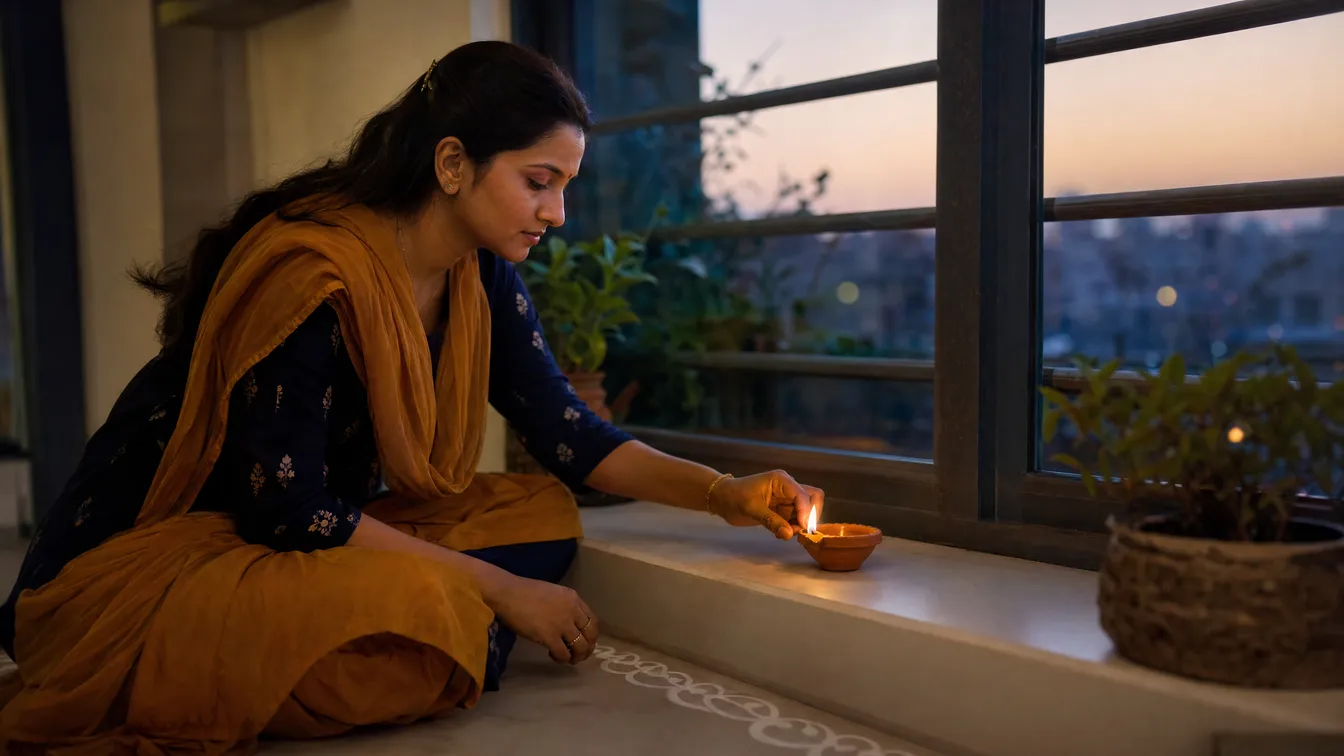
Set aside 20 to 30 minutes in the days before or after Diwali. If you like, light four small diyas or candles, one for each step, and keep a notebook nearby.
- The first diya: release. Write down one thing from this year you are ready to set down: a resentment, a habit, a fear. Read it once, breathe out slowly, and close the page.
- The second diya: forgive. Name one person, possibly yourself, against whom you are choosing to stop holding a grudge. You do not need to tell them.
- The third diya: thank. List five specific moments from this year that you are grateful for. Be as detailed as you can.
- The fourth diya: intend. Write one gentle intention for the coming year. Not a strict resolution, but a direction, for example "I will rest without guilt" or "I will speak up kindly".
Keep the intention somewhere you will see it, perhaps inside your wallet or on the fridge, so that it travels with you beyond the festive week.
Frequently asked questions
What is the deeper meaning of Diwali?
Diwali is widely understood as a celebration of light over darkness, with different stories and customs across regions and communities. On a personal level, many people also see it as a time for renewal: cleaning, reconnecting with loved ones and reflecting on the year that has passed.
How do I set an intention for the new year?
Choose one short, positive statement that describes how you want to live rather than what you must achieve. Keep it gentle and realistic, write it down, and revisit it every month. An intention is a compass, not a test, so it is fine to drift and return.
How can I let go of the past and start fresh?
Start small. Name what you are carrying, decide what is worth keeping, and consciously release one thing at a time. Practices such as journaling, forgiveness and gratitude help shift attention from what was to what can be. Fresh starts are rarely one big moment. They are built from many small choices.
We wish you a Diwali full of light, warmth and gentle new beginnings. If you would like support in closing old chapters and stepping into the year ahead with clarity, our Women's Empowerment workshop is a practice, not a lecture, and ends with a personal practice plan. For groups and organisations, we also design custom workshops.